BlackBerry 10: Type, swipe a word

WorldWide Tech Science. BlackBerry 10: Type, swipe a word and don`t look back for space. Video.RIM has posted a video on youtube to explain the advantages of its BB10 keyboard, you can type, swipe a suggested word. You also don`t need to worry about a missing space between the words you are...

This is default featured post 2 title

Go to Blogger edit html and find these sentences.Now replace these sentences with your own descriptions.This theme is Bloggerized by Lasantha Bandara - Premiumbloggertemplates.com.

Showing posts with label satellite. Show all posts

Monday, September 10, 2012

Video: French wine growers get help using satellite technology.


WorldWide Tech & Science. Francisco De Jes�s.


Video: French wine growers get help using satellite technology.
Wine growers in the south of France are using satellite technology to observe their vines as they ripen, leading to targeted harvesting and a higher quality product.
The annual grape harvest has begun in France's celebrated Chateauneuf-du-Pape wine region. Oenologists like Didier Robert have high hopes for this year's vintages.
DIDIER ROBERT, OENOLOGIST: "This is a really pretty white wine from Chateauneuf-du-Pape. Very fruity and with good freshness. This is the style we are looking for." ... and they're looking for it from above. A number of French vintners are now using satellite imaging to ensure optimum quality of the wines they produce. The service, called Oenoview, scans the terrain and provides computer-generated images, which indicate variations in the vines and soil type. This helps wine growers gauge ripeness in different areas of the vineyard so that harvesting happens at the most favorable time. Cedric Hallereau, manager at the Cooperative Wine Institute, says it's not just harvesting that benefits, but also pruning and fertilizing.
CEDRIC HALLEREAU, VINEYARD MANAGER AND WINE-GROWING CONSULTANT AT THE CO-OPERATIVE WINE INSTITUTE "We can see color differences which allow us to target our actions in the vineyard, to see what these different zones have to do with the quality of the grape, to be able to separate them during the harvest and then also to be able to use this map for fertilizing, pruning and removing buds and so on." The Fortia Chateau vineyard in Chateauneuf-du-Pape uses the technology on its entire 31 hectare estate at a cost of 5,000 euros a year. Manager Pierre Pastre says it's money well spent.
PIERRE PASTRE, MANAGER OF THE FORTIA CHATEAU IN CHATEAUNEUF-DU-PAPE: "Thanks to the mapping of this plot, we have been able to prune quite severely in February/March this year, and just adjusting the numbers of bunches in June/July by so-called 'green picking'. So now we can take the benefit to have a very nice bunch of grapes." About 30 wine-growers use Oenoview in France, and the concept is being exported to Canada, Morocco, Greece and Japan. And soon, sipping a glass of fine wine may produce a much more predictable finish.
DIDIER ROBERT, OENOLOGIST: "The map will help us to obtain this result every year because we can choose the right vineyard to elaborate the right style of wine." ... which for both growers and consumers adds up to the perfect combination.
Monday, August 20, 2012

Ecuador to launch its first satellite "Pegasus". Students desks will become spaceships.


WorldWide Tech & Science. Francisco De Jesùs.


Ecuador to launch its first satellite "Pegasus". Students desks will become spaceships.

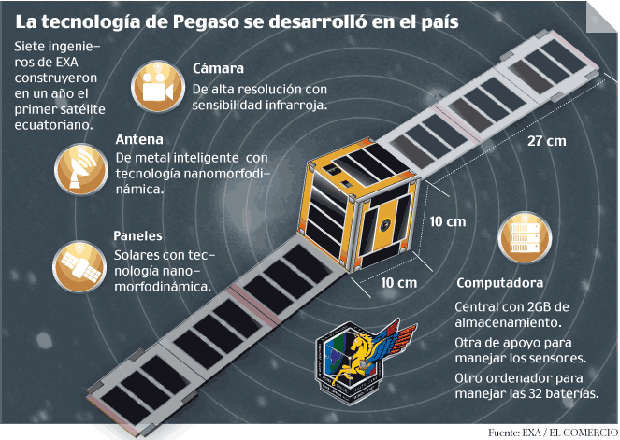
LA TECNOLOGÍA DE PEGASO SE DESARROLLÓ EN EL PAÍS

 Pegaso en  rplica.                               Luis Montenegro, Hanz  Vera y   Joan Erazo (Col. Nuevo Mundo)  miran el satlite.

Students from the Nuevo Mundo High School, Guayaquil-Ecuador, observe the replica.


The desks will become spaceships. And from the classroom may experience what feels an astronaut in space. It's not science fiction.

Pegasus, the first satellite built 100% in Ecuador, will challenge the magic of Hollywood and become a direct window to see Earth from the classroom. How will he do?

A beep makes the ears tingle. Followed by another scream, similar to a fax. Disturbingly, almost unbearable. The first is a morse code hiding his name and that of their creators. The other conveys the image of a winged horse, surrounded by the tricolor  (Ecuador flag)

The NEE-01 Pegasus is a nanosatellite. It measures 10 by 10 inches, has a cube and weighs just 1.2 kilograms. In April 2011, after 1000 hours of testing, the Ecuadorian Civilian Space Agency (EXA) concluded assembly.

This November 20 will be launched into space on board and take a video camera to broadcast live from orbit. In space, Pegasus will star Asteria program, a space platform dedicated to education. Send two signals: the first will contain questions of science and technology.

The second image. These signals are decoded by receptadas and Hermes-A earth station installed by EXA in Guayaquil. And over the Internet will reach young children and school and college. If a student answers the question successfully access the camera Pegaso and see the planet from space live, as the astronauts from NASA.

"We want to create a generation of Titans in engineering, you see, hear, have contact with the space and know that this is not Chinese or alien or otherworldly," says Ronnie Nader, EXA COO. To execute this mission, EXA outlined a pilot. New World Colleges (Guayaquil), Academia Cotopaxi (Quito) and Rosa de Jesus Cordero (Cuenca) will be the first to see and apply information from Pegasus to their curricula. Then join other campuses.

The system will be similar to the 'A satellite classroom', applied since 2009. Through this group of children had access, in real time, American satellites NOAA-15, NOAA-17, NOAA-18 and NOAA-19. They orbit the Earth every 90 minutes. They fly more than 800 miles high, reporting more than 30 climate variables. Margot Solberg's second grade teacher at the Academia Cotopaxi. Her students are between 7 and 8 years and meteorologists are small, able to download and analyze weather images.

"It's convenient. Between 2009 and 2010 we obtained data from a drought and the children learned to anticipate this kind of phenomenon and take precautions. " The graphics are captured by NOAA satellites. Then fetched by the Hermes A-Minotaur station, capable of connecting to the Internet permanently outer space. "We were the first to make that connection. Innocently thought that earth stations already existed, like in the movies.

 But there was no such thing, it was just another Hollywood glamor, "says Nader. Deputy Minister of Telecommunications of the Information Society, Ricardo Quiroga, says the country is preparing to support the millions of downloads of the curious who want to look out the window of Pegasus. "4 or 5 years ago the country had just over 1000 miles of fiber optics.

Today we have over 12,000. That puts us in fiber optic capacity to assume the technological challenge that emit this signal mean video, live, to everyone ". At 22:00 on 20 November Pegaso take off from a Russian base.

Travel in a former nuclear missile, along with other 24 satellites of 11 nationalities. The freight cost USD 500,000 and will be funded by the Government. Two days after the release of data sent. Astronaut Nader says the first sign will be the national anthem echoing in the cosmos.

"It will take about 100 minutes to circle the Earth ... 12:00 when will pass through Ecuador. "


The Pegaso countdown flashes on the EXA site. The Friday night missing 95 days, 5 hours, 49 minutes, 5 seconds ... According to projections EXA, 937 seconds after liftoff Pegaso be ejected into orbit. At 1500 seconds display their antennae, which measure about 45 centimeters. The orbit of the NEE-01 Pegasus reach 900 km and an inclination of 98 °. Its design is 50% aluminum and 50% titanium. EXA created a simulation chamber to test space environment, with temperatures between -198 (frozen air) and 30 degrees.


Share

Twitter Delicious Facebook Digg Stumbleupon Favorites More